SME Confidence Tracker Q1 2026
Higher costs absorbing profit gains and stifling SME growth

The SME Confidence Tracker Q1 2026 provides insight into how small and medium‑sized enterprises (SMEs) across the UK are starting the year. The latest findings show businesses are under increasing pressure from a challenging economic environment, while still trying to maintain ambition for growth and investment.
“While overall confidence levels have markedly dropped, six in ten are expecting sales growth between now and the summer, rising to 70 percent among those using external finance.”
Derek Ryan, CEO for North West Europe at Bibby Financial Services
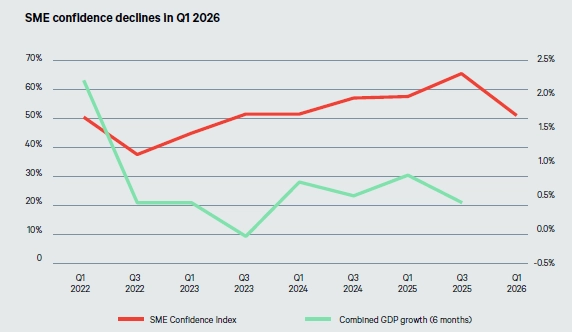
After a period of gradual improvement, confidence among UK SMEs has weakened. The SME Confidence Index, which combines current profitability with expectations for sales growth over the next six months, fell to 51 percent in Q1 2026, down from a peak of 66 percent in Q3 2025.
This marks a return to levels last seen in late 2023 and early 2024, reflecting a more cautious outlook as weaker growth, elevated costs and ongoing cashflow pressures continue to shape business decision making.
Despite this decline, 55 percent of SMEs say they are profitable today, while a further 38 percent say they are breaking even.
Download the latest SME Confidence Tracker:
Sales growth continues despite cost pressures
Just over half (53%) of SMEs report an increase in sales over the past six months, reflecting continued determination to trade through a challenging environment. Looking ahead, 61 percent expect sales to grow between now and the summer, with stronger expectations among manufacturing (63%) and wholesale (68%) businesses – as well as those using external finance.
High costs continue to stifle growth
High costs and inflation remain a persistent challenge. Though down from 66 percent 12 months ago, over half (56%) of SMEs still see these factors as the biggest challenge they face.
Other key challenges include:
- Energy costs
- Cashflow pressures
- Interest rates
- Higher taxation
Rising wage bills, sustained inflation and increases in the corporate tax burden have turned the high-cost environment into a new normal for many SMEs. As a result, financial headroom remains limited and margins are under pressure.
Access to finance remains key to unlocking growth
Access to external finance remains central to SME growth ambitions, particularly as businesses look to invest in technology, AI and machinery. Digital investment remains a priority, with over a third (36%) planning to invest in IT or digital tools in the next six months, rising to 43 percent in wholesale and 41 percent in transport.
However, investment appetite has dampened compared with last year. The average amount SMEs expect to invest over the next 12 months has fallen by nearly a quarter (24%), from £270,377 in Q1 2025 to £205,915 today – reflecting caution rather than a lack of ambition.
- 50 percent of SMEs say it is harder to access external finance than six months ago
- 22 percent have had an application for finance rejected
Among those using or considering external finance, 40 percent primarily use it to fund expansion or investment, while 32 percent rely on it for day-to-day operations.
AI adoption grows across UK SMEs
AI is emerging as a growing focus for SMEs. Seventeen percent say it will be their primary investment area over the next six months, reflecting its expanding role across business functions.
Three quarters (75%) of SMEs report having used AI in the past year. The most common applications are sales and marketing (34%), operations and administration (27%), and financial strategy and decision-making (23%).
Counting the true cost of late payments
Late payments continue to have a material impact on SMEs’ ability to operate and grow. Over the past year, payment delays have disrupted salary payments for 42 percent of SMEs, rising to 48 percent of manufacturing firms.
More than four in ten (41%) have drawn on emergency funds because of late payments, eroding cash reserves intended to support resilience and investment.
Bad debt, through irrecoverable unpaid invoices, continues to impact SMEs. Three in 10 (30%) experienced losses in the past year – with the manufacturing sector one of the most exposed (36%).
Confidence in government support remains low
While over half of SMEs (55%) feel confident that the UK economy is set up for the future, this sentiment has yet to translate into decisive action. Nearly half (46%) are delaying major investment decisions until after the Spring Statement, with larger SMEs (52%) and those in manufacturing and transport (each 50%) most likely to pause.
SMEs’ top priorities for government action include:
- Simplifying taxes and introducing incentives
- Lowering energy bills and employment NICs
- Taking tougher action against late payments