2026 Trading Places Report
Global pressure is reshaping how UK SMEs trade

14 June 2026
The Trading Places 2026 report shows how UK SMEs are navigating international trade in an increasingly challenging environment. The latest findings highlight how global trade is becoming harder to manage as rising costs, disruption and changing payment terms put pressure on cashflow and decision making. At the same time, businesses are changing how they trade, from switching suppliers to rethinking where they operate in order to stay in control.
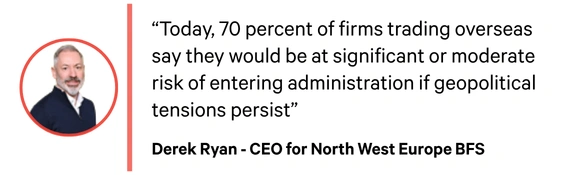
Concern about global conflicts among importers rose to 48 percent in 2026, up 9 percent from 2025, while more than half of SMEs reported readjusting their foreign exchange (FX) strategies. Exchange rate volatility is also having a direct impact on profitability, affecting 40 percent of SMEs.
As risks increase, rising costs, delays and currency losses are combining to reduce liquidity.
Download the 2026 Trading Places report:
Cashflow strain and currency volatility are now the norm
Cashflow is tightening as customers delay payments while suppliers demand earlier settlement. Nearly 7 in 10 SMEs report worsening cashflow, driven primarily by shipping and logistics costs (61%) and delayed invoice payments (42%).
Currency volatility driven by geopolitical tensions has eroded SME profit margins, with 44 percent of SMEs saying they have been impacted by FX movements. Those impacted are experiencing an estimated average loss of £71,600, while 52 percent also report energy price inflation as a key driver. These factors combine higher operating costs with exchange-rate losses, increasing financial risk.
Supply chain pressures are also intensifying, with 26 percent of SMEs reporting increased customer insolvency and 36 percent of overseas partners requesting upfront payment. FX‑related fraud is also becoming more common, with one in five SMEs experiencing attempted fraud in 2026, showing how risk is spreading across supply chains.
Europe begins to emerge as a preferred hub for global trade
There has been a shift in the top five export markets for UK SMEs compared to 2025.
France (36% up from 13% last year) and Germany (34% up from 13% last year) now sit above the US (29% down from 30% last year). Europe is increasingly preferred due to its proximity, lower complexity and reduced FX risk. 36 percent of SMEs report a reduction in US export turnover following newly imposed tariffs, while 27 percent have actively reduced their US exposure.
In terms of importing, China remains dominant (34% up from 23% last year), but there has been strong growth in nearshoring to Europe. Germany is now in second place (31% up from 12% last year) and France in third place (23% up from 9% last year). To protect margins from currency risk and trading disruption, SMEs are increasing supplier diversification, expanding global sourcing to countries such as Canada (13%), India (11%), Japan (8%) and Australia (7%).
Geopolitical risk is now a dominant challenge
Global conflicts are now the top macroeconomic concern for both importers and exporters, cited by 48 percent of businesses in 2026, overtaking tariffs, inflation and interest rates, which were the main concerns in 2025.
The recent Middle Eastern conflict with Iran has affected 74 percent of SMEs, with the main disruptions cited as freight and logistics issues (51%), export restrictions (34%) and compliance cost increases (34%). Importers face higher cost impacts with average reported losses of £43,209 compared to £38,929 for exporters, but both have a material impact on SME cashflow.
Macroeconomic issues cited by exporters (2025 vs 2026):
| Economic challenge | 2025 (NET Export) | 2026 (NET Export) | Change |
|---|---|---|---|
| Global conflicts | 40% | 48% | +8pp |
| Tariffs, customs, or trade barriers | 58% | 48% | -10pp |
| Interest rates | 48% | 41% | -7pp |
| Global inflation | 45% | 39% | -6pp |
| Cost of doing business overseas | 41% | 38% | -3pp |
| Political uncertainty | 38% | 35% | -3pp |
| Supply chain disruption | 30% | 28% | -2pp |
| Ongoing impact of Brexit | 32% | 34% | +2pp |
| Currency volatility | 25% | 29% | +4pp |
Weakening business confidence leads to more cautious outlook
Business confidence has weakened significantly over the past year, with 38 percent of exporters now expecting volumes to fall (up from 27%) and 36 percent of importers expecting declines (up from 19%).
Growth is becoming harder to sustain, with the proportion of exporters reporting rising sales falling from 45 percent last year to 35 percent in 2026. This has not discouraged SMEs, however, as many continue to seek partnerships in new markets. India, Canada and Japan have each seen increases of between 1 and 5 percent in importer interest in 2026.
SME response and conclusions
SMEs continue to adapt to market volatility. They are building resilience by adopting structured FX strategies, improving credit control and seeking flexible financing options. They are also diversifying trade by expanding suppliers and customers, while reducing reliance on single markets. In parallel, many are de-risking by shifting towards Europe and domestic markets while increasing their supplier base – for example, the average number of suppliers used by SMEs has increased from 13 to 15 in 2026.
Volatility is no longer temporary; it is now part of the trading environment. Cost pressures are now built into supply chains and geopolitical developments are shaping business decisions. SMEs are responding, but without better access to finance and a simpler trading environment, sustaining growth will remain challenging.
Bibby Financial Services has been providing funding to SMEs for over forty years. If your business is looking to improve working capital, we can support through our Invoice Finance and Asset Finance solutions. If you are seeking to trade more efficiently overseas, talk to our experienced foreign exchange team.